




If you've started shopping for solid wood console tables, you've already noticed how thin the market is once you filter out the engineered fakes. Most of what shows up online is veneer over MDF, sold at prices that hide what's really under the finish. This guide is for the buyer who's ready to skip that part — the one who wants a console table that looks better in twenty years than it does on day one, that fits a real American home, and that earns the wall it sits against. We'll walk through what makes a wood console table different from the disposable alternatives, the design directions that define the modern console market, how to choose one that works in your space, and why A & E Bowery Lighting has become the go-to source for buyers who want the real thing.
What Makes Solid Wood Console Tables Worth The Price

The phrase "solid wood" gets thrown around loosely. Once you understand what separates the genuine article from the engineered version, the price difference makes sense.
Real Wood Behaves Differently
A solid wood console is built from continuous hardwood — the grain runs through the piece, not just across the surface. There's no MDF core, no veneer skin, no glued-on layer waiting to chip. A handcrafted console table in real wood feels heavier in the hand, sits more solidly on the floor, and resists the slow disintegration that engineered furniture goes through after a couple of moves. The difference is immediate the moment you set something on it.
It Ages Instead Of Wearing Out
Engineered console tables have a shelf life. The veneers peel where edges meet, the joints loosen, and the printed grain fades into something obviously fake. Real hardwood does the opposite. It darkens slightly with age, gathers small marks from keys and mail and the daily life of an entryway, and develops a surface character no factory finish can imitate. The console you buy today, if it's made right, will look more interesting in your next house than it does in your current one.
How To Spot The Real Thing
Three quick checks separate solid wood from imitation. Look at the edges and undersides — solid wood shows the same grain on every surface, while veneer reveals a particleboard layer where the skin meets the substrate. Lift one end if you can; solid hardwood is genuinely heavy, while engineered pieces feel suspiciously light for their size. And look at how the grain behaves across joints — on real wood, the grain breaks naturally at corners, while printed surfaces often repeat the pattern or stop abruptly where panels meet.
The Design Directions Of Modern Console Tables

Once you've committed to real wood, the next question is what kind of statement the piece should make. The contemporary console market has settled into three clear directions.
Sculptural And Hand-Carved
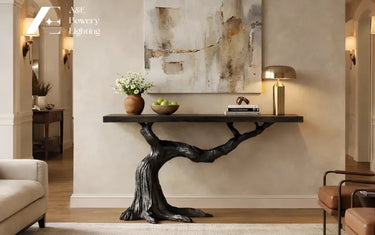
The most expressive direction is sculptural — console tables shaped by hand into flowing forms with twisted pedestals, branch-like supports, and asymmetric bases. A sculptural console table functions as much like a piece of art as a furniture surface, and it's the right call when the wall behind it has the visual space to let the piece breathe. These work especially well in entryways, where they set the tone for the rest of the home. Once you've chosen a sculptural piece, our guide on how to style a console table walks through what to put on it without burying the form.
Architectural And Geometric
For more restrained interiors, the architectural console is the answer. Clean horizontal lines, a clear structural base, and a strict geometry — these pieces add a horizontal anchor to a wall without competing with the rest of the décor. The wood grain still does the warming work; the form simply gets out of the way. This style suits modern apartments, minimalist living rooms, and any space where the rest of the design is doing enough talking.
Organic And Branch-Inspired
The third direction is the organic form — console tables with bases that look pulled from nature, with branch-like supports, root-inspired pedestals, and silhouettes that feel grown rather than built. This style works particularly well alongside neutral upholstery, natural fibers, and rooms that lean into a relaxed material palette. The form is less formal than the architectural option but more refined than rustic farmhouse alternatives.
How To Choose A Console Table That Works In Your Home

Picking the right console is mostly about being honest about where it's going and what it has to do. Three questions get you most of the way there.
Match Length To The Wall Or Sofa
For an entryway console, leave at least eight to twelve inches of breathing room on either side of the piece — anything tighter reads as crammed. For a console behind a sofa, the table should be roughly the same length as the sofa back, give or take a few inches; anything shorter looks lost, anything longer reads as a separate piece of furniture. If you're still deciding between forms, our piece on the difference between a console and a sideboard covers when each one earns its place in a room.
Get The Height Right
Console tables are typically twenty-eight to thirty-four inches tall. For an entryway, aim for the upper end of that range so the piece works as a landing surface for keys, bags, and mail without requiring a stoop. For behind-sofa placement, the table should sit roughly level with the top of the sofa back or just below it — this is the single most common detail people get wrong. A sofa console table that's too tall blocks the sightline; one that's too short disappears.
Pick A Wood Tone You'll Live With
Wood tone is the longest-lasting visual decision. Lighter woods — ash, oak, maple — open up entryways and pair well with white walls. Darker woods — walnut, deeper-stained oak — anchor larger living rooms and read as more formal. Whichever you choose, look for natural oil finishes rather than heavy lacquers, since oils let the grain stay visible and let the piece age the way real wood is supposed to age. For more on placement-specific selection, our entryway console table guide covers the details.
Why A & E Bowery Lighting Builds The Console Worth Keeping

Plenty of brands sell wood console tables. Very few sell the kind that match what's described above. Here's where A & E Bowery Lighting fits, and why it's where serious buyers tend to land.
One Material, Used Honestly
Every console in the catalog is made from solid, natural wood — no veneers, no composites, no engineered cores. That single decision changes everything downstream: the weight, the joinery, the way the piece ages, and the way it holds value across decades. When the brand says "solid wood," it means solid wood all the way through.
Hand-Shaped, Not Stamped Out
The sculptural lines, twisted pedestals, branch-form bases, and organic silhouettes that define the catalog are shaped by hand — not pressed out by an automated CNC at industrial scale. That's why no two pieces are quite identical, and why the silhouettes feel softer and more human than what comes out of a big-box assembly line. For buyers who want furniture with genuine character, the difference is visible the moment the piece arrives.
Sized For Real American Homes
The catalog is designed around how Americans actually use console tables. Generous lengths for real entryways, proper heights for landing keys and bags, behind-sofa proportions that work in real living rooms, and structural mass that holds up under daily use. Combined with free U.S. shipping and a thirty-day return policy, the buying experience matches the quality of the product.
Conclusion
A console table, done right, is one of the most quietly important pieces in a home. It's the first surface guests see in an entryway, the architectural anchor behind a sofa, the spot where daily life intersects with intentional design. Buying a real wood piece — one that's built from one material, shaped by hand, and designed to age rather than wear out — is the difference between a purchase you make once and one you keep remaking every five years. A & E Bowery Lighting Console Tables Collection is built for the first kind of buyer. Browse the full Console Tables Collection when you're ready to choose a piece worth keeping. For deeper reading, see our guides on how to style a console table, console table versus sideboard, and choosing an entryway console. Or start at our homepage to see the full catalog.
