




The right entryway console table does something most furniture can't — it shapes the first impression of an entire home. Walk through any well-designed front door and the console is what your eye lands on first: the surface where keys and mail collect, the wall that anchors the lamp, the piece that quietly tells anyone walking in what kind of home they've just entered. Get it wrong and the whole entryway feels temporary. Get it right and the rest of the house has a head start. This guide walks through why the entryway deserves a real piece of furniture, the practical specs that separate functional from frustrating, the styling that makes the space work daily, and why a solid wood console table is where serious buyers end up when the front door deserves something built to last.
Why The Entryway Deserves A Real Piece Of Furniture

Most people underspend on the entryway and overspend on the living room. That's backwards. The entryway is the highest-traffic furniture zone in the house, the first thing every guest sees, and the place where daily life intersects with home design more than anywhere else.
It's The Most-Seen Surface In The House
Every guest sees it. Every delivery driver sees it. Every member of the household passes it dozens of times a day. A foyer table that looks cheap reads as a cheap home no matter what's in the rest of the rooms. A console that looks intentional sets the tone for everything else, and that tone is set in the first three seconds of anyone arriving.
It Does Real Daily Work
Unlike most decorative furniture, an entryway console earns its keep daily. Keys land on it. Mail collects there. Bags get set down on top of it while someone fishes for their phone. That working role means the materials matter more than for purely decorative pieces. Engineered wood scratches and stains under that kind of use; solid hardwood absorbs it and looks better for the wear.
It Shapes The Whole House's First Impression
Interior designers talk about the entryway as the design "thesis statement" of a home — the piece of communication that sets up everything that follows. A solid wood console with real presence tells visitors that the rest of the house is going to reward attention. A flat-pack alternative tells them the opposite, regardless of what's actually in the living room.
The Practical Specs That Make An Entryway Console Work

An entryway console has to perform every day, which means the specifications matter as much as the aesthetics. Get these three right and the rest is styling.
Length And Wall Clearance
Measure the wall first, then choose the console. Leave at least eight to twelve inches of breathing room on either side of the piece — anything tighter reads as crammed. For most American entryways, a console between forty-eight and sixty inches long works well; longer than that requires a generous wall, shorter than that often looks lost. If your narrow hallway table spot is tighter than usual, look for pieces specifically proportioned for compact entries.
Height For Daily Function
Console tables typically run twenty-eight to thirty-four inches tall. For an entryway, aim for the upper end of that range — thirty-two to thirty-four inches — so the piece works as a landing surface for keys, bags, and mail without requiring a stoop. A console that's too low forces you to bend every time you set something down, which is the kind of small frustration that adds up over years of daily use.
Depth Against The Wall
Entryway consoles should be relatively shallow — twelve to eighteen inches deep. This keeps the piece from intruding into the walking path, which matters in narrow entries where every inch counts. The narrow profile also makes the console read as architectural rather than as a piece of furniture parked in front of the wall.
Styling An Entryway Console For Daily Life

The trick with entryway styling is balancing the design with the daily working surface. Three guidelines make it easy.
Always Start With A Lamp
An entryway console without a lamp is a missed opportunity. The vertical line balances the horizontal form, the warm light makes coming home feel like coming home, and the daily function justifies the surface space. A table lamp paired with a wall-mounted mirror above the console handles most of the styling work before you add anything else.
Build A Catch-All That Looks Intentional
Keys and small items have to live somewhere. A small handsome bowl or ceramic dish, placed deliberately, turns the daily mess into an intentional vignette. Entryway organization stops looking like clutter the moment you give it a designated home with visual weight. A leather valet tray, a hand-thrown ceramic, or a small wood bowl all work — the key is choosing one piece that earns its job.
Leave The Working Surface Clear
The most common entryway styling mistake is filling every inch of the console with decorative objects. The console is a working surface — keys, mail, sunglasses, a bag for a moment — and it has to have empty space to receive that daily flow. Leave at least a third of the surface intentionally bare, so the console can do its job without feeling like you're disturbing a still life every time you come through the door.
Why A & E Bowery Lighting Builds The Entryway Console Worth Keeping
The entryway is the hardest spot in the house for engineered furniture, because it gets used hardest. That's exactly where solid wood proves its worth.
Built To Hold Up To Daily Use
An A & E Bowery Lighting console is designed to absorb the daily wear of an entryway without showing it. Solid hardwood doesn't dent the way veneered MDF does, doesn't scratch into the underlying particleboard, and doesn't stain when something wet gets set on it. The marks it does pick up over the years become character, not damage.
Sized For The Front Door, Not The Showroom
Many of the consoles in the catalog are proportioned specifically for real entryway use — the right height for landing keys and bags, the right depth to stay out of the walking path, lengths that work in actual American foyers rather than oversized showroom dimensions. That's a quiet design choice that makes the difference between a console that fits and one that fights the room.
Sculptural Forms That Read From The Door
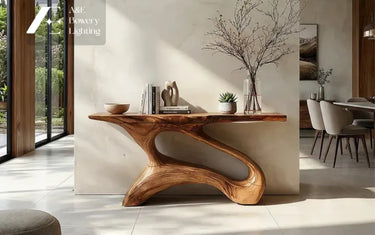
Because an entryway console is the first thing a guest sees, the form matters from a distance. The hand-shaped silhouettes, twisted pedestals, and organic bases in the catalog are designed to read as sculpture from across the room, which means the console works as architecture, not just as a surface. That's what an entryway thesis statement is supposed to do.
Conclusion
The entryway is the smallest design problem in the house and the most consequential. The console table that solves it has to be functional enough for daily use, beautiful enough to earn its place as the first thing every guest sees, and built to last through years of being the hardest-working piece of furniture in the home. The A & E Bowery Lighting Console Tables Collection is built specifically for that job — solid hand-shaped wood, proportioned for real American entryways, designed to absorb daily wear and return it as character.
