




Most online console table styling ideas are written for photo shoots, not for the homes people actually live in. They tell you to balance every surface with one perfectly placed brass object, layer three vases of identical ceramics, and color-coordinate your books to match the wall. That advice produces a beautiful Instagram square and a deeply uncomfortable room. This guide is different. It's written for the person who actually drops keys on the table, leaves mail there for a day or two, and wants the piece to look intentional without looking staged. We'll walk through why styling a console matters, the rules that quietly make a surface look designed, what actually belongs on a real wood console, and why pieces from solid wood console tables are easier to style than almost anything else on the market.
Why Styling A Console Table Is Worth The Effort

A console table is one of the most visible pieces of furniture in any home — usually the first surface a guest sees in the entryway, or a major horizontal anchor in the living room. Treat it as an afterthought and the whole space feels half-finished.
It Sets The Tone For The Room
An entryway console is the design equivalent of a handshake. It's what tells anyone walking in what kind of home this is — careful, lived-in, considered, casual. A well-styled console behind a sofa does something similar from the other direction, framing the seating area with a horizontal anchor that the rest of the room organizes around. Either way, the piece carries more visual responsibility than its size suggests.
It Makes The Wood Earn Its Place
You spent real money on a solid wood console because the material matters. Good console table decor doesn't bury that — it edits the surface so the wood itself stays part of the composition. The grain, the hand-shaped form, the joinery — these are what justify the price tag, and they only contribute when you can actually see them.
It Costs Nothing Extra
Unlike most home upgrades, styling costs nothing. The objects are already in your house. The only investment is twenty minutes of attention every few months and a willingness to put some things into storage that you don't actually need on display.
The Rules That Make A Console Look Designed

There are four quiet rules that separate a designed-looking console from a chaotic one. None of them are difficult. All of them are habits.
Work In Threes
The eye reads odd numbers as compositions and even numbers as inventory. Group objects on the console in clusters of three — three small ceramics, a stack of three books topped with a small object, three framed photos of varying heights. This single trick makes the most visible difference, and it's also the easiest entryway styling habit to develop.
Build A Vertical Anchor
A console is a horizontal piece, which means it needs a vertical element to balance the form. A table lamp is the obvious choice, but a tall vase, a piece of leaning art, or a wall-mounted mirror above the console all work. Without something pulling the eye upward, the console reads as a flat shelf rather than a designed vignette.
Leave Negative Space
The most common mistake in console table arrangement is filling every inch of the surface. A solid wood console is beautiful in itself — its grain, its joinery, its hand-finished top — and covering it completely defeats the reason you bought real wood. Leave at least a third of the surface intentionally bare, so the eye has somewhere to rest and the wood can show.
Keep The Function Visible
An entryway console serves a daily purpose: keys, mail, bags, the small landing-pad rituals of coming and going. A console behind a sofa often holds a lamp, a remote, maybe a drink. Styling that ignores those functions creates a piece you have to clear off every time you actually use it. Better to design the styling around the function rather than around it.
What Belongs On A Real Wood Console

Once you have the rules, the question becomes what objects actually earn their place on the surface. The answer is mostly: fewer than you think.
A Lamp, Always
If there's one object that belongs on almost every console, it's a lamp. The vertical line balances the horizontal form, the warm light makes the wood glow in the evening, and the daily function justifies the surface space. For entryway consoles, this is non-negotiable; the console is doing real work as a landing surface, and good lighting makes that work easier.
One Substantial Object, Not Five Small Ones
The instinct to scatter small objects across the surface produces clutter. The better move is to choose one substantial piece — a hand-thrown ceramic, a small wood sculpture, a stack of art books with a single object on top — and let it carry visual weight on its own. Substantial objects share the material honesty of real wood; mass-produced décor doesn't.
Personal Pieces That Tell A Story
Personal objects make the difference between a styled console and a generic one. A framed photo, a postcard from a place you love, a small heirloom, an interesting rock — these are what tell the story of the home. Use them sparingly, but use them. A console with three meaningful objects beats one with thirty bought-for-the-shelf items every time.
Why A & E Bowery Lighting Consoles Style So Easily

Some console tables fight you when you try to style them. The proportions are wrong, the finish is too loud, or the design is so generic that anything you put on it looks misplaced. A & E Bowery Lighting consoles work differently — they make the styling easier from the start.
The Wood Does Half The Work
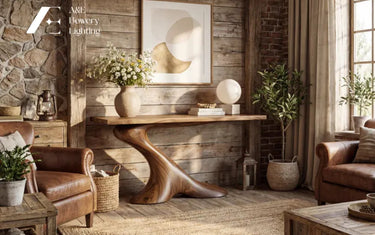
When the console itself is solid hand-shaped wood, you don't need to compensate for it with elaborate decor. The grain, the carved forms, and the hand-finished surface contribute their own visual weight, which means a sparse styling looks intentional rather than empty. The piece is already a statement; you just have to not bury it.
Sculptural Bases That Read From Every Angle
Many of the brand's consoles feature twisted pedestals, branch-form supports, and organic silhouettes that look as good from the side as from the front. That's especially valuable for consoles placed behind a sofa, where the back of the piece is visible from across the room. Generic flat-pack consoles don't give you that — their bases are built to be hidden.
Built To Hold The Daily Story
A solid wood console from A & E Bowery Lighting isn't styled for a single season. It's designed to live with you across years, which means the styling can evolve — new objects, new framed photos, new chapters of life — without the console ever feeling outdated. That's a quiet advantage that flat-pack alternatives can't offer.
Conclusion
Styling a console isn't about chasing magazine perfection. It's about taking a piece of furniture you already own, editing what sits on it, and letting the wood and the objects tell a story together. The rules are simple, the cost is zero, and the difference is the kind of thing visitors notice without quite knowing why. If you're starting from scratch and looking for a console worth styling in the first place, the A & E Bowery Lighting Console Tables Collection is built specifically for this kind of long-game decorating — pieces that look better with time, not worse. Browse the full Console Tables Collection when you're ready to choose, or visit our homepage to explore the rest of the catalog.
