



Choosing between one basin and a double tree trunk vanity is usually framed as a lifestyle question, but it is really a measuring question. Two people getting ready at the same time is a genuine daily benefit, and it is also the fastest way to ruin a bathroom if the wall cannot carry it. Two basins forced into fifty-nine inches leave both users elbowing each other, and the counter that was supposed to hold your things ends up holding nothing at all.
The honest answer is that most American bathrooms are better served by one well-placed basin and a generous stretch of usable counter. Two basins are worth it only above a certain width, and knowing exactly where that line falls will save you from an expensive mistake in a room you cannot easily undo.
1. What Makes the Single Versus Double Decision So Important?

It Cannot Be Reversed Cheaply
Adding a second basin later means new supply lines, a new drain, and a new hole in a solid timber top that was never designed for one. This is not a decision you revisit in a year. It is settled the day the plumber roughs in the wall, which is why it deserves more thought than the ten minutes most people give it while browsing product photos.
Counter Space Is the Hidden Cost
A second basin does not arrive for free. It consumes the surface you would otherwise use for a folded towel, a soap dish, or the stack of everyday things a bathroom accumulates. On a mid-width vanity, that trade is rarely worth making, because you gain a sink you use for four minutes a day and lose a counter you rely on constantly.
An Open Base Doubles the Visible Plumbing
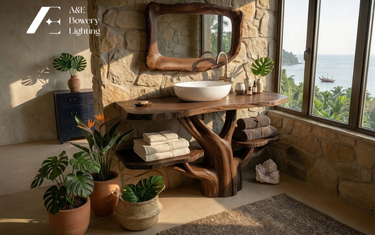
A conventional vanity hides its pipes inside a cabinet. A tree trunk vanity does not. Two basins mean two sets of supply lines and two drains descending in plain view between the sculptural supports, and that visual cost is real on a piece whose base is the whole point. It is entirely manageable, but it must be planned rather than discovered on installation day.
2. Benefits and Trade-Offs of Each Layout

How Much Room a Basin Actually Needs
Each basin wants roughly thirty inches of centerline-to-centerline spacing as an absolute floor, and closer to thirty-six inches to feel unhurried. It also needs about twenty inches from its centerline to the nearest side wall so nobody bangs an elbow on tile. Run that arithmetic and two basins need close to seventy inches before they stop competing with each other, not the fifty-nine that a specification sheet might technically permit.
Where the Line Falls on Our Size Ladder
Our vanities step through forty, forty-seven, fifty-nine, seventy-one, and eighty-six inches. Anything at forty-seven and below is a single sink vanity, full stop. Fifty-nine inches can be forced to take two basins, but the counter between them vanishes and the piece stops working as a surface. Seventy-one inches is where a double layout genuinely breathes, and eighty-six is where it becomes luxurious.
What a Single Basin Buys You Instead
A forty-seven inch top with one centered basin still leaves genuinely useful counter on both sides, which is what most households need every morning. Deciding bathroom vanity width is therefore not about the largest piece that fits, but about how much clear surface remains once the basin has taken its share. In most bathrooms, that surface is worth more than a second sink.
3. How to Plan a Layout That Actually Works
Centering Versus Offsetting a Single Basin
A centered basin is the symmetrical choice and suits a vanity that sits on an open wall as a focal point. An offset basin, pushed toward one end, gives you one continuous run of usable counter instead of two short ones, which is far more practical in daily use. Offset works especially well in an alcove, where it lets you push the working surface toward the open side of the room.
Aligning Two Basins With the Base Structure
On a twin pedestal design such as our Handcrafted Solid Wood Vanity Console with Sculpted Twin Pedestal Base, the supports are structural and their positions are fixed by the form of the piece. Basins must sit so their drains fall clear of those supports, which usually means they land outboard of the pedestals rather than directly above them. A vessel that lands squarely on top of a carved root is a plumbing problem no goodwill will solve.
Buy now: Handcrafted Solid Wood Vanity Console with Sculpted Twin Pedestal Base
Planning the Plumbing You Will See
A double sink vanity layout on an open base means budgeting for exposed bottle traps in a finish that complements the timber, rather than the chrome P-trap your plumber has in the van. Matte black suits our black finish, and brushed brass or bronze sits well against walnut. On a wide piece such as our Double Tree Base Live Edge Wood Vanity, that single detail is the difference between plumbing that reads as design and plumbing that reads as an oversight.
Buy now: Double Tree Base Live Edge Wood Vanity Natural Solid Wood Bathroom Console
4. Why Choosing A & E Bowery Lighting Is the Best Option for Your Double Vanity
Widths That Cover Both Answers
Because our vanities run from thirty inches to eighty-six, you are never forced to squeeze two basins into a piece that cannot carry them. If your wall supports a double layout, the width exists. If it does not, there is a single-basin size that fits properly, and choosing it is not a compromise.
Twin Pedestal Designs Built for Two
Our double tree base and twin pedestal consoles are designed from the start around two supports and a long span, so a wide top neither sags nor looks unresolved through the middle. That structural honesty is what lets a seventy-one or eighty-six inch piece stay visually light instead of becoming a slab.
Solid Wood, Handcrafted, Made to Last
Every piece is solid timber with a live edge top and a hand-carved base, in walnut or black, built to live in a humid room for decades. Because it is furniture rather than cabinetry, it can move with you and be refinished rather than demolished. Browse the wider catalog on our homepage.
5. Conclusion
The single versus double decision is settled by a tape measure, not by preference. Below fifty-nine inches, take one basin without hesitation. At fifty-nine, one basin will still serve you better than two. At seventy-one inches and above, a double layout finally has the room it needs, provided you plan the exposed plumbing and keep the basins clear of the pedestal supports.
For the full sizing framework behind this decision, read our guide to what size tree trunk bathroom vanity you should choose. Before you place an order, work through our tree trunk bathroom vanity buying guide for first-time buyers. Every width discussed here is available in the A & E Bowery Lighting Tree Trunk Bathroom Vanities Collection, handcrafted in solid wood.
